
The Old Wreck at Dell Quay, Chichester
- Sep 16, 2025
- 5 min read
Updated: Sep 21, 2025
Painting the Old Wreck at Dell Quay, Chichester – Watercolour Sketch & Tips
The Old Wreck at Dell Quay, Chichester – A Study in Stillness and Decay
An in-depth look at painting the old wreck at Dell Quay, Chichester: process, challenges and result.
“Where shall we go for Sunday lunch?” asked Annie.
“How about Dell Quay? The weather is good — and it’s very popular with artists.”
We were staying in Haslemere for a few days this summer, visiting Chris’s cousin, Annie. I always love the area, and as usual I came away with ideas and subjects I want to paint — including her home.
(Check out the gallery above if you’d like to see some of the scenes)
A Strange Sense of Recognition
Dell Quay. The name sounded familiar, though I couldn’t place it. As soon as I stepped out of the car, though, I felt a sudden connection, even though I’d never been here before. Somehow, I’d painted this place — or at least, a version of it — years ago. It was in a tutorial by Geoff Kersey. His on line lessons taught me a lot in my early forays into painting. If you’re new to it, his website Watercolour Landscapes is well worth a look.

Above is the more traditional shot that everyone seems to take or paint. I myself might well use this photo and paint the scene again, one day, but that’s not the one I chose for this blog. Turning to my right I found a much more interesting subject.

The Painting Process: Challenges & Insights
I didn’t get around to painting this until September, when I was on holiday in San Joan D’Alacant — under a blazing sun, battling sciatica. It was 34 °C, and working with watercolour at that temperature forced some adjustments. Everything dries in a flash. No swelling of the paper or the need to stretch or wet it first. Just a few strips of masking tape are all that is needed.
I used Artix 350 gm Tempera paper, which is almost smooth in finish and available here in Spain. One thing about photographing the work: I was under a yellow sail shade to shield from UV — helpful, but it slightly skewed the colour in the photos not that my photography is any good anyway.
This would be a challenge and something I would enjoy painting in watercolour. I have subsequently tried to find out more information about this wreck and continually draw a blank. What my sketchy research did turn up, is how little anyone knows about it’s history. I’m sure there is someone out there who will add more information in the comments below but I have drawn a blank. The wreck is reputed to be the most photographed boat in the area and has become a local landmark. How long it will stay there I don’t know so, for posterity, I thought I would create a legacy painting. Below are a few shots of the process and painting’s development.

The first wash was the sky. I have never fully bought in to the current trend of creating clouds using Cirulean or Ultra Marine blue, adding red or rose pigment shades to create a grey/purple shadow under the cloud. When I study cloud formations I never see the purple colour that other artists do. To me it’s more a grey based on Paynes Grey. My wife always accuses me of being colour blind especially when I’m getting dressed, it’s a man thing !
I have changed my approach over time when creating clouds and skys. I rarely wet the whole area of sky but prefer to add the blue/grey using a loaded brush of sky colour then, to create the white clouds, I immediately use a tissue to pull out the colour. This creates the white space (cloud) and smooth edges where required but, I feel, creates more natural looking results. Other areas I leave completely dry where the sky is effectively white paper. I might even do a blog on this at some point to demonstrate the technique as my explanation above, on re-reading, is not easy to follow. It may not be the conventional way but it works for me.

So now it was about detailing and this is an area that we all learn makes the difference between a good painting and a not so good one. Is the finished result a good one? All I will say is art is subjective. If it works for you, it is, but not everyone will love your work. Have faith and keep working at it. Many times I have almost given up on a painting only to step away, take a break and then review again. In most cases improving the result, but not always. This is also the time to get a second opinion. A fresh pair of eyes always see things you don’t. Don’t be to proud to take criticism, you may not like it, you may ignore it, but every well meaning comment makes you appraise your work again.
The finished painting is below,
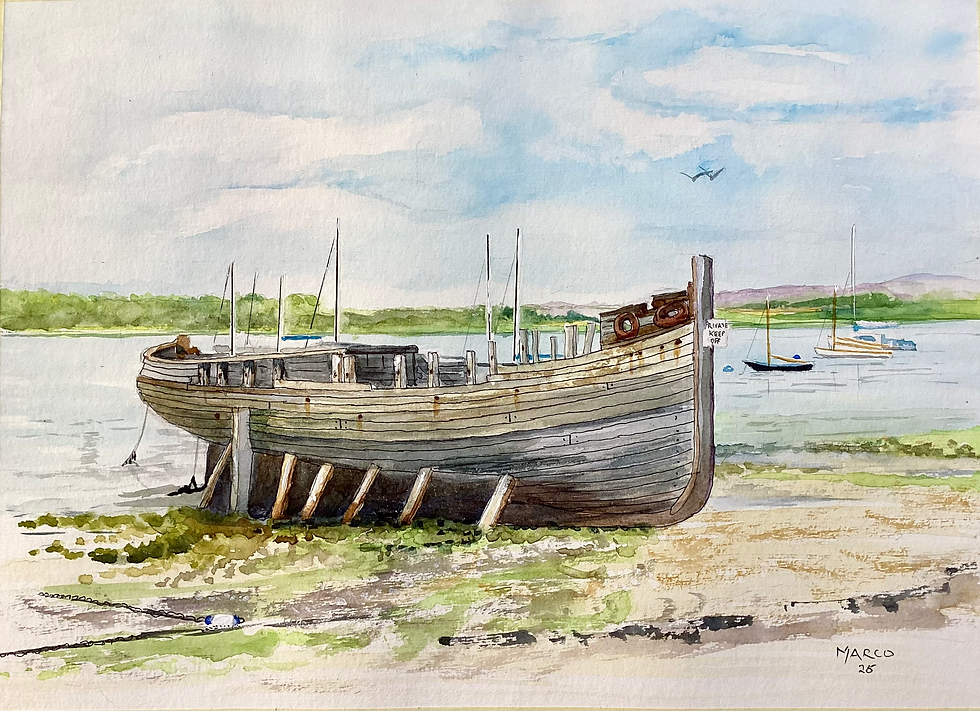
This is not just a depiction of the wreck, but a meditation on what’s left behind. There’s beauty in abandonment, in things that no longer serve a purpose but still stand with dignity. The wreck speaks of storms weathered, journeys ended, and the slow embrace of the natural world reclaiming what was once manmade. There does appear to have been attempts at repair but old Father Time is winning.
Dell Quay itself has a gentle, working charm — boats bobbing in the tide, birds threading through the reeds, and always the quiet sense of the past lingering. It’s a place where history isn’t shouted, but whispered. And this old wreck is part of that whisper — a reminder of lives lived on the water, of stories that may never be told, but still deserve to be seen.
Painting it was both a challenge and a joy. I hope it captures not just the shape of the boat, but the feeling of standing there — with boots in the mud, salt in the air, and time held still.
I have to be honest this was more of a challenge than I first thought it would be. Getting the colour balance and beach to look realistic was particularly difficult and took quite a lot of trial and error on a separate piece of paper. I would love to find out more about this old girl and her working history. Please feel free to comment below, I like it and we artists are never satisfied so, for once, I will bask in my glory……Until my wife see’s it :-)
Enjoy.
Marco.
Tips for Painting Weathered Boats & Abandoned Structures
Use layered washes to capture wood textures.
Apply dry brush techniques for cracks and details.
Emphasise contrasts: solid vs. fragile, colour vs. faded tones.
About Dell Quay & the Wreck’s Local Story
Dell Quay was once a vital port for Chichester, with a history stretching back to medieval times. Today, its charm lies in its quiet atmosphere and scattered remnants of that maritime past. The wreck is a living monument, slowly returning to nature.
For more on Dell Quay history, visit Chichester Harbour Conservancy.
Further Reading & Resources


Comments